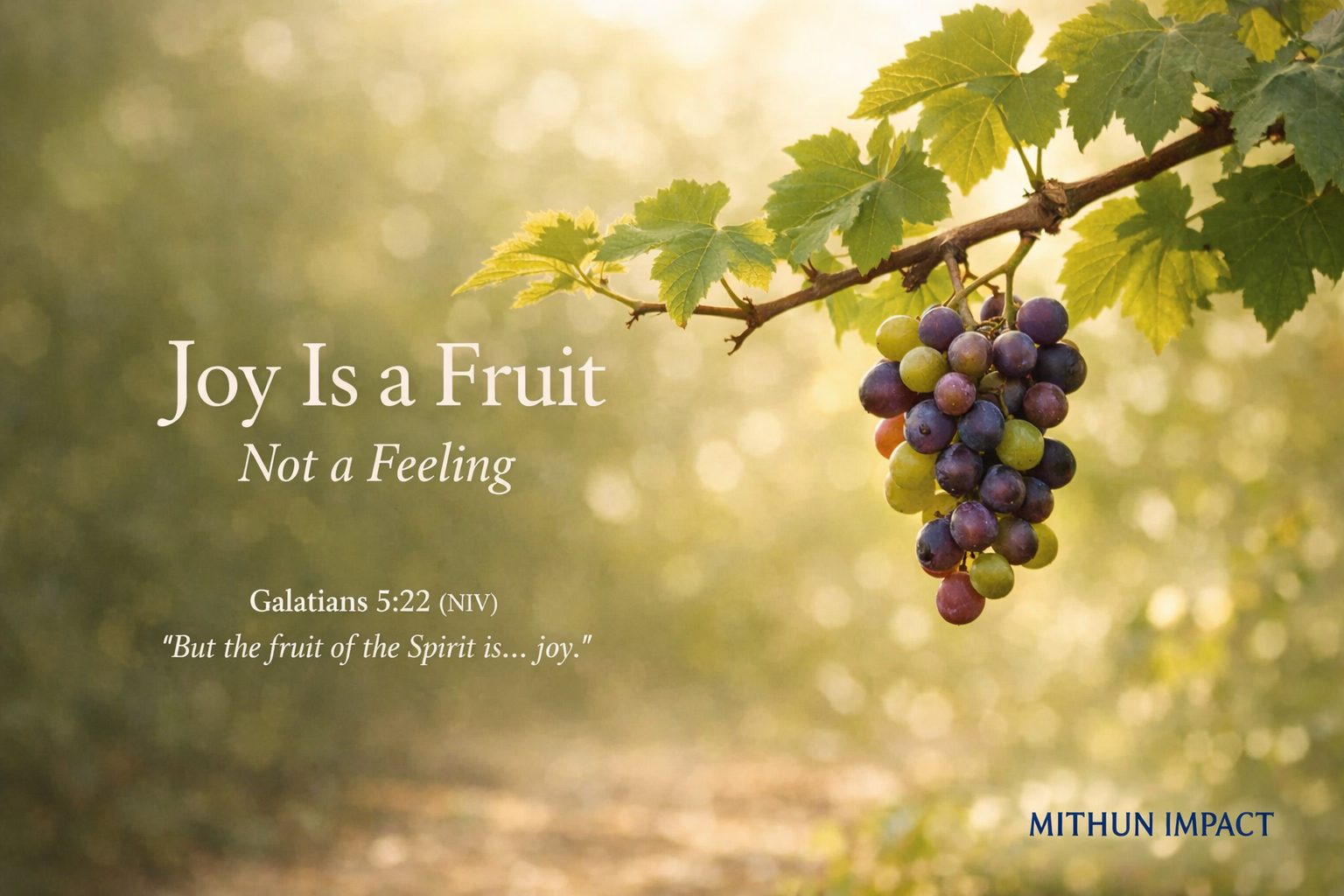
Joy Is a Fruit, Not a Feeling
Many believers quietly wrestle with the same discouraging thought: If I truly trusted God, shouldn’t I feel more joyful? We equate joy with emotion, mood, or spiritual enthusiasm—and when those feelings fade, guilt often replaces peace. But Scripture offers a far more freeing truth: joy was never meant to be manufactured by effort or sustained by emotion.
The Bible doesn’t describe joy as a feeling we summon. It describes joy as fruit.
In Epistle to the Galatians, joy is listed as part of the fruit of the Spirit. That language matters. Fruit grows. It develops over time. It cannot be rushed, forced, or faked. Fruit is not produced by striving—it is the natural result of remaining connected to the source that gives life.
That distinction alone changes everything.
Feelings are unpredictable. They rise and fall with sleep, stress, health, circumstances, and the weight of the day. If joy depends on how we feel, it will always be fragile. That’s why so many people experience short bursts of happiness but struggle to find steady joy. Emotions were never designed to be the foundation of our faith.
Joy, according to Scripture, is deeper than emotion. It is the quiet strength that grows when we walk consistently with God. It doesn’t shout. It doesn’t demand perfect circumstances. It holds steady when life feels uncertain.
This is where many believers misunderstand joy. We assume that if we don’t feel joyful, something must be wrong with our faith. But spiritual growth doesn’t always feel uplifting. Sometimes it feels like pruning. Sometimes it feels like waiting. Sometimes it feels like obedience without immediate emotional reward.
And yet—this is often where the deepest fruit is forming.
Joy grows in proximity to God. It develops when we stay connected through prayer, Scripture, and trust, even when emotions lag behind. Just as a branch doesn’t strain to produce fruit, believers are not called to strain for joy. We are called to remain—faithful, rooted, and surrendered.
This also means that joy is not a sign that life is easy. In fact, some of the strongest joy is formed in seasons of difficulty. When control is released. When certainty is absent. When faith becomes a daily decision rather than a feeling.
For discouraged believers, this truth is liberating. Not feeling joyful does not mean your faith is weak. It may simply mean God is working beneath the surface, strengthening roots that will later support fruit you cannot yet see. Growth is often invisible before it becomes evident.
This reframes how we live. Instead of chasing emotional highs, we focus on faithfulness. Instead of judging our spiritual health by how we feel, we measure it by where we remain connected. Joy becomes less about mood and more about maturity.
Practically, this means choosing prayer over panic, truth over fear, and trust over control—especially on days when joy feels distant. It means continuing to walk with God even when feelings don’t cooperate, trusting that fruit is forming in time.
Faith doesn’t ask us to pretend everything is fine. It invites us to stay connected and let God do what only He can do. Joy is not something we summon. It is something God grows.
And joy that grows from faith doesn’t fade with circumstances. It lasts.